market_report Dry bulk Markets & trade Splash247
Bulk carrier freight markets in August continued their five-month flatline with the Baltic Dry Index averaging 1,688 points so far after a four-month streak of 1,731; 1,895; 1,922 and 1,925. A finely balanced market is largely failing to respond to macro influences such as China’s repeated attempts to apply economic defibrillators to its myocardially infarcted construction sector. Still, the capesize sector has hauled itself from its slumber in August as miners in Australia begin their autumn season. C5, the capesize route from west Australia to north China, added 41% in the first three weeks of August, moving from $19,400 a day to $27,300 a day on the back of a $1.57 per tonne increase in freight to $10.91 on August 20. C3, the Brazil-China route, responded more slowly with a 6% increase in per tonne rates over the same dates from $23.87 to $25.41, which equated to a 14% increase in time charter equivalent earnings to $23,807 per day. These gains were however offset by a weaker Atlantic market for iron ore. But the weighted C5 average was still up 13% to 22,319 in the first three weeks of August. The capesize market is a curate’s egg this year, with each peak being lower than the previous peak. Having hit a December 2023 average of 4,641 points, it recovered from Lunar New Year to peak at 3,768 points in March, fell back again, and recovered again to a new, lower peak of 3,080 points in July and averages 2,474 so far in August. But with five-year-old capesize prices being rated by brokers at or above $60m, confidence in these leviathans remains sky-high. Most owners, like their VLCC counterparts, are taking a longer view of restricted supply growth and an assumption that China will do whatever it takes to keep its economy growing at 5% a year or more. Panamax freight markets, if the Baltic Panamax Index is a guide, continue this month on their four-month gentle slide from a peak of 1,869 points averaged in May to 1,610 so far in August. Chinese business has been predictably slow in August. The China-Indonesia round voyage for coal fell 13% over the first 20 days of August to loiter at $13,688 on a standard panamax, while the parallel kamsarmax rate fell 11% to $11,769 per day. Even as China supposedly fears a reduction in soyabean availability from its US providers, rates from Mississippi to Qingdao fell 5% so far in August to $56.46 per tonne, resulting in a 9% fall in the time charter equivalent to $25,174 per day. Chinese buyers have supposedly switched to Latin American providers but the Santos-Qingdao panamax TCE is down 14% so far in August to a lowly $15,373 per day. The Atlantic is doing no better, with kamsarmax round voyages from W Europe to N America and back recording a 23% fall in daily TCEs to $11,695, while the parallel panamax TCE is down 25% to $10,411 a day. Does the expansion of panamax pool membership in August indicate some nervousness about market prospects? Pools can guarantee employment and can be considered a safe haven in a bear market. In the geared bulker markets, only two supramax / ultramax route reported any gains in earnings so far in August, and they were barely gains. S5, a lengthy trip from W Africa via the east coast of south America to north east Asia, added 2% for a 63,000 dwt vessel to sit at $22,829 per day, or $19,593 per day for a 58,000 dwt vessel. The shorter ultramax trip from the Indian Ocean via South Africa to northeast Asia added a miserly 1% over August so far to sit at $17,379 on Augus
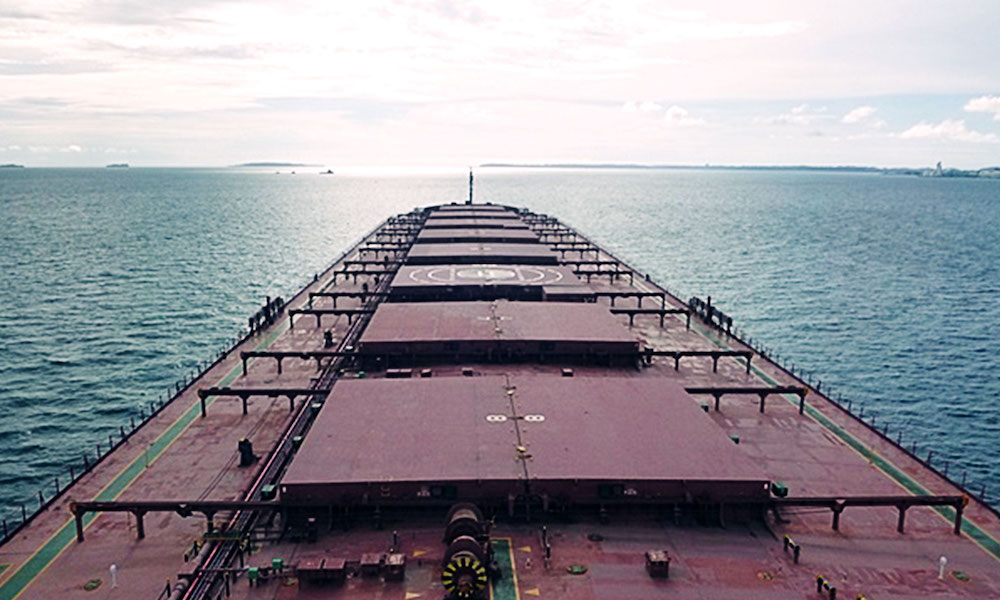
Have a break, have a capesize
Splash247
Read full article at Splash247 →
Opens Splash247 in a new tab