news Markets & trade Splash247
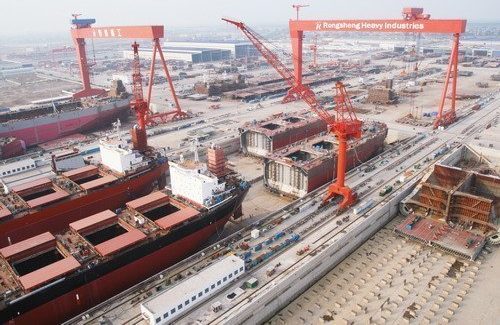
Shipbuilding capacity might be growing at its fastest pace since the global financial crisis of 2008, but some familiar bottlenecks are emerging that will hamper output. The current shipbuilding cycle is on the up and with deliveries of vessels extending to 2028 for bulkers, tankers, and boxships while gas carrier deliveries are being booked as far out as 2030. In terms of newbuilding capacity, the latest estimate from broker Arrow puts shipbuilding capacity across China, South Korea and Japan at 35.6m cgt per annum, a 20% increase from 29.5m cgt a year ago. Shipbuilding capacity in these countries is still around 30% below the 2000s shipbuilding boom but it is enough of a rise for many shipyards to either reopen or expand. International shipbroking house Gibson said recently the industry is in for a sustained period of high newbuilding pricing as well as choke points on labour costs and what it believes will be a very heated marine equipment supply chain, particularly regarding main engines. Original equipment manufacturers (OEMs) will be hard-pressed to manufacture everything required in the remaining years of the 2020s. “If OEMs such as engine and containment system manufacturers are to meet demand they must invest in extra productive capacity which probably means higher costs,” said Mark Williams, managing director of Shipping Strategy, a British consultancy. This is not the first time a boom has occurred and was immediately followed by experts predicting gloomy outcomes. This has happened before. The world’s most famous shipping economist, Martin Stopford, said that roughly the same thing happened in the late 1980s when analysts argued that in the 1990s the shipyard capacity – down to half its previous peak – would struggle to replace ships built in the 1970s shipbuilding boom and that labour shortages would inhibit expansion. “Both assumptions were wrong. By 1995 shipyard deliveries had increased by 90% and many tankers, which were supposed to have a 20-year life, went on trading to 30 years. Today we have the same sort of problem, but with a few extra rogue variables,” Stopford said. Shipyard production is now down to 80m dwt per annum which is half the 2011 peak – just like the 1980s – so escalating demand and choke points in the supply chain might also lead to high newbuilding prices as well, Stopford suggested. Dual-fuel engines are all in high demand, accounting for more than one in two orders today. Swiss engine manufacturer WinGD reported that these engines require up to 30% more time to assemble and test compared to a conventional engine. “The extra injection systems and more powerful control systems for handling more sensors and moving parts both have an impact on assembly time. Further, the engine has to be tested in both fuel modes, and sometimes in mixed mode, to prove reliable operation in all conditions and environmental compliance,” Volkmar Galke, director of sales at WinGD, told Splash Extra. “Main engine availability is certainly one of the merchant vessel-building bottlenecks and has been one of the reasons for slow production capacity expansion over the past 18 to 24 months,” said Thomas Bracewell, newbuilding projects and decarbonisation lead at Arrow. The earliest newbuilding deliveries under new contracts available in China today are generally at less experienced builders in the second half of 2026, and limited by the number of main engines available, with very few available to deliver to the builders before
Shipbuilding bottlenecks emerge
Splash247
Read full article at Splash247 →
Opens Splash247 in a new tab