news Geopolitical riskOperational risk Marine Insight
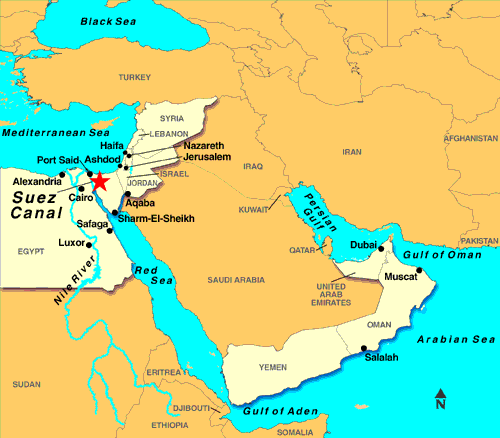
An unexpected consequence of the Israel-Hamas conflict was the disruption of commercial shipping in the Red Sea region. As the conflict intensified, the Houthis in Yemen launched missile attacks on vessels in the Red Sea. Given their strategic location at the crossroads of major East-West shipping routes, the Houthis were successful in severely impeding maritime trade on this route. Image Credits: Marine Insight The attacks, which started in mid-December 2023, continued despite airstrikes on launch pads and Houthi strongholds, with the intensity only waning towards the second half of 2025. During this period, Carriers were compelled to reroute vessels via the Cape of Good Hope (CoGH) to avoid the conflict zone and minimise potential risks to crew, vessels, and cargo. From the perspective of Carriers, while the CoGH routing helped maintain equilibrium between supply and demand and thus kept rates from falling due to oversupply of capacity, it considerably increased sailing times. With additional capacity being absorbed as more vessels were introduced on FEA-EUR services (to maintain weekly services despite longer sailing times), the pressure on freight rates eased somewhat. Impact on Countries and Ports: Regional and Trade-level The impact of the altered trade routing was felt by several countries. Image Credits: Marine Insight 1) Egypt It was directly affected, as the closure of the Red Sea route meant a drop in vessels using the Suez Canal. The Suez Canal is a major source of government revenue and generator of foreign currency for the Egyptian government, with revenues touching $10 billion in 2023. While the diversified and broad-based nature of the Egyptian economy means that it is not excessively reliant on revenues from the Suez Canal, it nonetheless witnessed a significant erosion in revenues and forex earnings, with the UNCTAD having estimated a 40% drop in revenue. Egypt has also recently reached out to Iran, hoping for a rapprochement that might be useful in getting Iran to control the Houthis (as Iran supports the Houthis militarily and ideologically). While a formal agreement has not been reached, statements have been made regarding the importance of ensuring smooth trade and safe passage of vessels in the Red Sea region (and by extension, ships sailing through the Suez Canal). 2) East African countries For East African countries, Europe is a major trading partner, with European trade flowing through the Suez Canal. The closure of the Canal meant a decline in European trade, which in the short term would be difficult to replace with other trade partners (due to commodity mix and existing trade policies). 3) Southern and West African Ports They saw a surge in vessel calls, as most vessels sailing via the CoGH now call at ports en route (i.e ports in South and West Africa). South African ports, however, were unable to fully capitalise on this development, hindered as they were by systemic infrastructural challenges, while West African ports faced congestion, cargo handling delays and vessel backlogs. 4) Middle Eastern countries Transhipment ports, especially, have been affected in the Middle East. While ports handling domestic cargo would likely continue handling the cargo, unless the cargo is diverted to other ports or transported via other modes (unlikely given that the sheer capacity of maritime transport means other rail and road modes cannot transport cargo at the same scale, and thus cannot be considered viable options, a
Suez Canal Shipping 2026: Risks, Carrier Strategies & Impact On Ports

Marine Insight
Read full article at Marine Insight →
Opens Marine Insight in a new tab