news Geopolitical riskMarkets & trade Splash247
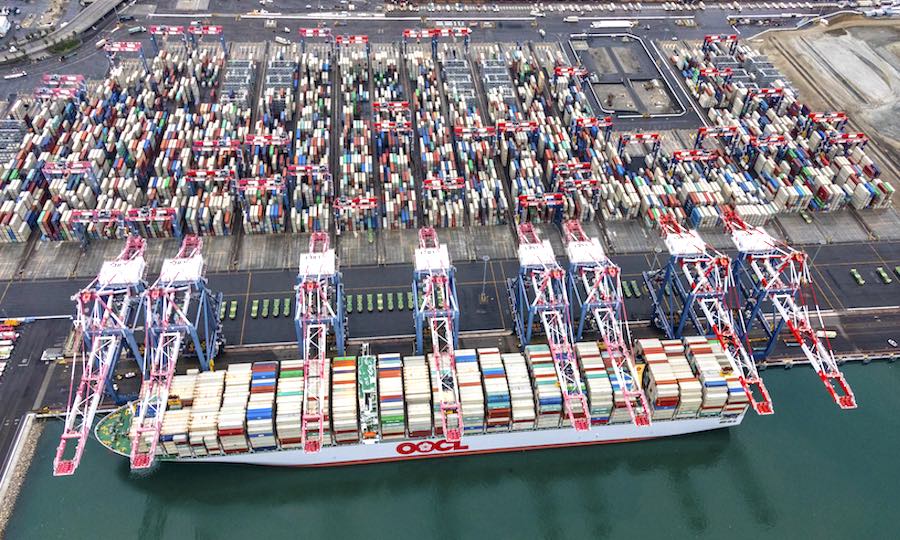
Shipping spent the weekend digesting the news from the US where watered down plans to charge China-linked ships extra for American port calls have created considerable outrage in Beijing and Hong Kong, while causing consternation for members of the Ocean Alliance, one of the big groupings in container shipping. The 42-page document released by the US Trade Representative (USTR) has been pored over by world shipping and has attracted criticism for its lack of clarity. “The USTR announcement is detailed but poorly worded, leaving certain aspects open to interpretation,” noted broker Arrow. Under the new rules announced late last Thursday by the USTR, non-Chinese shipowners will be charged the higher of two calculated fees: a tonnage -based fee, starting at $18 per net ton as of October 14, 2025, and gradually increasing to $33 per net ton by April 17, 2028, or a container-based fee, starting at $120 per container discharged on October 14, 2025, that will increase to $250 per container by April 17, 2028. Non-US-built ships carrying cars will be charged $150 per vehicle. The fees will be applied once each voyage on affected ships, a maximum of six times a year. Temporary suspension of the fee—up to a maximum of three years—may be granted if the vessel owner orders and takes delivery of a US-built ship of equal or greater net tonnage. Exemptions apply to smaller vessels, ships on domestic voyages as well as to the Caribbean and in the Great Lakes, and certain specialised vessel types. Also exempt are empty bulk carriers arriving at US ports to load up with exports such as wheat and soybeans. The measures do not apply to container vessels smaller than 4,000 teu. They also do not apply to voyages shorter than 2,000 nautical miles. Chinese shipowners and operators do look to be hit with far higher bills. They will initially be charged $50 per net ton, rising by $30 a ton each year for the next three years. According to Clarksons, in terms of 2024 port calls, only 7% of containerships would be subject to the new fees as compared to 83% under the initial USTR proposal published in February, which came in for heavy criticism at a public hearing in March. Across all shipping, only 9% of 2024 port calls would be subject to these new fees versus 43% under the prior proposal. “Under this policy US crude oil, refined products, LNG, LPG, chemicals, coal and grains exports should see little impact; containers will see some disruption but not as previously feared; car carriers however will see an impact given all foreign ships will be subject to port fees of $150 per ceu,” shipping analysts at Jefferies, an American investment bank, summed up. The way the fees have targeted Chinese operators could see big shifts on the transpacific liner trades in particular. China’s COSCO and OOCL are part of the Ocean Alliance along with France’s CMA CGM and Taiwan’s Evergreen. Hede Shipping is another niche independent Chinese operator on the transpacific. Calculations by Sea-Intelligence, a Danish liner consultancy, suggest these three Chinese liners could be hit with US port fees of as high as $10m when the USTR fees are fully phased in, something that could see the Ocean Alliance shuffle operations, whereby CMA CGM and Evergreen handle the US-bound services and relegate COSCO and OOCL to Asia-Europe. The World Shipping Council (WSC), a liner lobby group, has hit out at the new fees, especially on the car-carrying ones. “Unfortunately, the fee regime announced by UST
Beijing vents fury at US port fees
Splash247
Read full article at Splash247 →
Opens Splash247 in a new tab

