casualty_report Container Safety & casualtyOperational risk Marine Insight
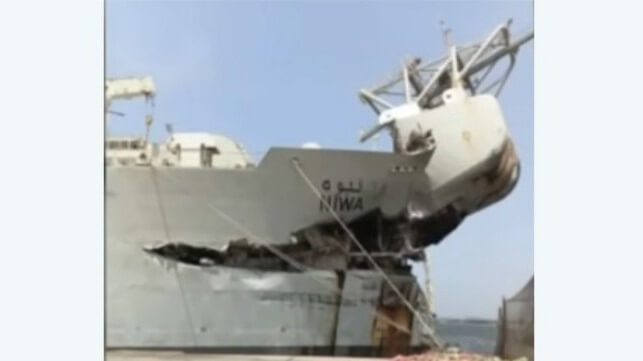
The vessel was about three-quarters of the way through loading. At the same time, the vessel was discharging contaminated oil from a double-bottom tank. The Master, who was standing on the quay, witnessed the ship take a heavy roll as one of the 20-foot containers was lifted. He was told by the stevedores that the weight of that container was 20.8 tonnes and that the planned stow for it was on the second tier on bay 4 on deck. The Master temporarily stopped loading for about 10 minutes and informed the Chief Officer that he was not happy with the second tier of containers in bay 4. The C/O then altered the stow from the second tier on bay 4 to the bottom tier on bay 5. When loading resumed, there were about twenty containers still to load. Whilst lifting the third to last container, using the ship’s own crane, the vessel suddenly heeled over to port towards the quayside. The Master attempted to control the list with the ballast, but this did not produce the desired effect; the vessel continued to list further until she capsized. The Master and C/O attempted to free the vessel’s moorings but failed. The subsequent official enquiry found that the proximate cause of the capsize was the attempted lift of a heavy container from the wharf at a time when the ship had little or no residual stability. The suspension of the heavy container from the jib of the crane caused a large and sudden heel to port which took the vessel to an angle beyond which all righting levers were negative (capsizing levers). The vessel was unable to recover, and capsize became inevitable. At this stage nothing could be done to remedy the situation, which in a very short time was exacerbated by the shifting of cargo containers across the deck and sea water flooding the engine room through an open trap hatch on the main deck. The Chief Engineer stated that he believed the cargo containers on deck shifted at the same time as the lurch. By the time he arrived down the Engine Room, some two minutes after the initial heel to port, it was already completely flooded due to the open trap hatch on the main deck. The violent heel was probably temporarily arrested by the wharf fenders. However, at this stage the vessel had no righting levers and complete capsize eventually followed as the capsizing lever took over and the hull was ‘levered’ out away from the wharf. The following factors contributed to the unstable condition of the vessel and her subsequent capsize and sinking: No regard was paid by the ship’s staff to the importance of preparing a curve of righting levers (GZ’s) for the vessel in her loaded condition. Too much reliance by the ship’s staff was placed upon the initial GM as a criterion for the vessel’s stability in all conditions of loading and at all angles of heel. No allowance was made for free surface effect when calculating the original GM of the vessel. The instructions in the stability booklet clearly state that KG corrected for free surface must be used. The casual approach by the ship’s staff to the calculation of the original GM. There appeared to have been a disagreement between the C/O and a previous Master as to the value of the KG of the cement in the holds. Both opinions were wrong and an incorrect value had been used. This was a major factor in the miscalculation of the stability. No attention was paid to a letter written by the owners, this indicated that a Deck Cargo Licence had been granted for 740 tonnes, being consistent with condition No 7 in t
Real Life Incident: Container Ship Capsizes Whilst Loading At Port
Marine Insight
Read full article at Marine Insight →
Opens Marine Insight in a new tab