news Compliance & regulationDecarbonization & energy Manifold Times
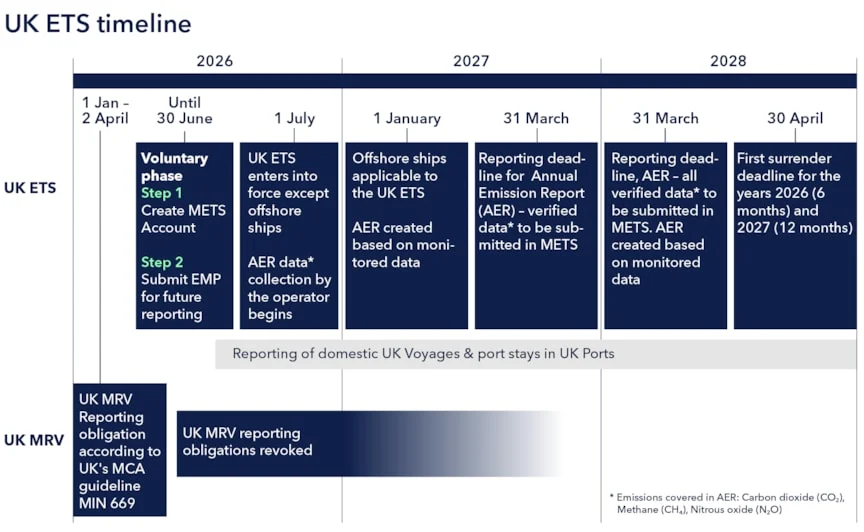
Classification society DNV on Friday (5 June) highlighted key information and implications of the UK Emissions Trading Scheme, which will be expanding to maritime activities from 1 July: The UK Emissions Trading Scheme (ETS) is rapidly evolving, shaping how industries price and manage greenhouse gas emissions as the UK moves toward net-zero. As the scheme expands and its carbon market strengthens, understanding its key mechanisms and implications is becoming increasingly important for the maritime sector. UK ETS implementation timeline The UK ETS expands to maritime activities from 1 July 2026, and the implementation timeline for the UK ETS in shipping introduces several steps that operators need to follow to be compliant. One of the first requirements is the submission of an Emissions Monitoring Plan (EMP) by the ship operator to the regulator (an equivalent to the EU ETS administering authority). An EMP is submitted per company (operator) and includes relevant data such as a list of ships, their particulars, emission sources, etc. The EMP does not undergo assessment by a verifier but instead is subject to approval by the regulator. Operators must use an independent verifier accredited by UKAS, such as DNV, to verify their Annual Emissions Report (AER), a company-level report. Operators must submit their AER by 31 March each year and must surrender the number of emissions allowances by 30 April. The deadline to surrender allowances for the first scheme year (1 July to 31 December 2026) will be 30 April 2028. A standard reporting year runs from 1 January to 31 December, while in 2026, only half of the year is subject to reporting (from 1 July, 2026). A summary of the timeline is illustrated in the following figure: Further, Appendix 1 provides an annual wheel illustration of the UK ETS process. UK ETS scope and compliance cycle As of 1 July 2026, the UK ETS applies to cargo and passenger vessels of 5,000 GT and above, with the inclusion of offshore ships delayed unt
UK ETS expansion to maritime sector: DNV outlines key mechanisms and implications
Manifold Times
Read full article at Manifold Times →
Opens Manifold Times in a new tab